IS NULL Operator
The is null command is used to fetch records with no value or null value. It is used in the where clause.
Example:
select * from employees where phone_number is null;
The above code will fetch employees whose phone_number is null or has no value inserted.
Result:
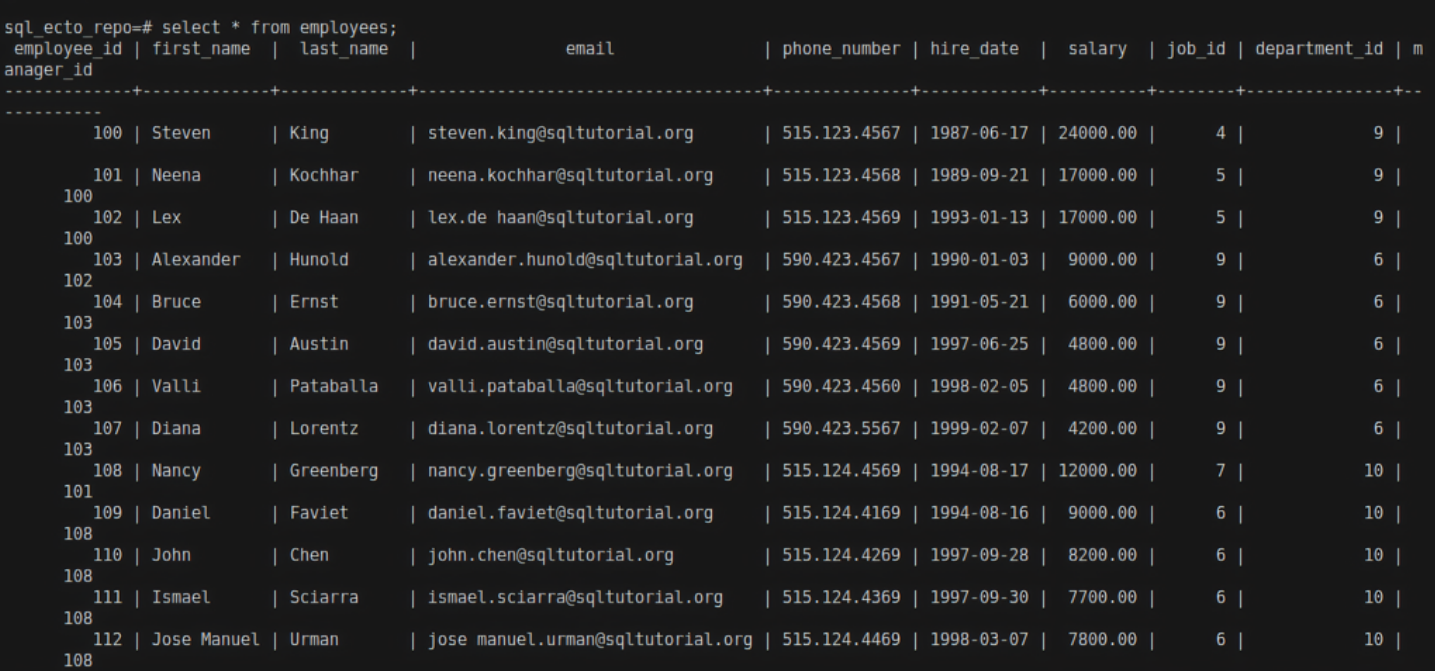
In the above example, you can see that for all 6 rows, there is no value inserted in the phone_number column.
Ecto query for is null
is_nil/1
Expression
In Ecto.Query, you can achieve this using the is_nil/1 function.
Example:
HR.Employee
|> where([c], is_nil(c.phone_number))
|> HR.Repo.all()
The above code searches in the HR.Employee struct where phone_number is set to nil.
where([c], is_nil(c.phone_number)) -> Here [c] is the reference variable that is used to refer to HR.Employee. Refer Aliases in Ecto to know about aliases/reference variables.
IEx(11)> HR.Employee |> where([c], is_nil(c.phone_number)) |> HR.Repo.all()

[
  %HR.Employee{
    __meta__: #Ecto.Schema.Metadata<:loaded, "employees">,
    employee_id: 145,
    first_name: "John",
    last_name: "Russell",
    email: "john.russell@sqltutorial.org",
    phone_number: nil,
    hire_date: ~D[1996-10-01],
    salary: Decimal.new("14000.00"),
    manager_id: 100,
    job_id: 15,
    department_id: 8
  },
  %HR.Employee{
    __meta__: #Ecto.Schema.Metadata<:loaded, "employees">,
    employee_id: 146,
    first_name: "Karen",
    last_name: "Partners",
    email: "karen.partners@sqltutorial.org",
    phone_number: nil,
    hire_date: ~D[1997-01-05],
    salary: Decimal.new("13500.00"),
    manager_id: 100,
    job_id: 15,
    department_id: 8
  },
  %HR.Employee{
    __meta__: #Ecto.Schema.Metadata<:loaded, "employees">,
    employee_id: 176,
    first_name: "Jonathon",
    last_name: "Taylor",
    email: "jonathon.taylor@sqltutorial.org",
    phone_number: nil,
    hire_date: ~D[1998-03-24],
    salary: Decimal.new("8600.00"),
    manager_id: 100,
    job_id: 16,
    department_id: 8
  },
  %HR.Employee{
    __meta__: #Ecto.Schema.Metadata<:loaded, "employees">,
    employee_id: 177,
    first_name: "Jack",
    last_name: "Livingston",
    email: "jack.livingston@sqltutorial.org",
    phone_number: nil,
    hire_date: ~D[1998-04-23],
    salary: Decimal.new("8400.00"),
    manager_id: 100,
    job_id: 16,
    department_id: 8
  },
  %HR.Employee{
    __meta__: #Ecto.Schema.Metadata<:loaded, "employees">,
    employee_id: 178,
    first_name: "Kimberely",
    last_name: "Grant",
    email: "kimberely.grant@sqltutorial.org",
    phone_number: nil,
    hire_date: ~D[1999-05-24],
    salary: Decimal.new("7000.00"),
    manager_id: 100,
    job_id: 16,
    department_id: 8
  },
  %HR.Employee{
    __meta__: #Ecto.Schema.Metadata<:loaded, "employees">,
    employee_id: 179,
    first_name: "Charles",
    last_name: "Johnson",
    email: "charles.johnson@sqltutorial.org",
    phone_number: nil,
    hire_date: ~D[2000-01-04],
    salary: Decimal.new("6200.00"),
    manager_id: 100,
    job_id: 16,
    department_id: 8
  }

<!-- and so on -->

]
Keywords
HR.Repo.all(from c in HR.Employee, where: is_nil(c.phone_number))
where is a key and it accepts a function as a value called is_nil/1. It accepts records from HR.Employee whose phone_number is nil.